

Do Natural Compounds Work Better Through Skin or Diet?
A guide to maximizing the benefits of natural ingredients through the right delivery methods

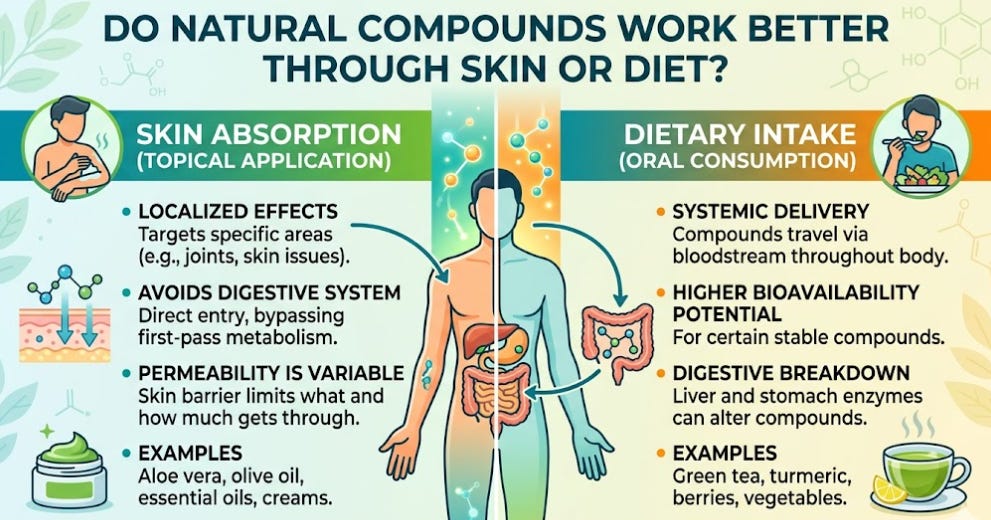
If you’ve ever stared at a bottle of high-end vitamin C serum while simultaneously wondering if you should just eat another orange, you’ve hit upon the central debate in modern wellness: Do natural compounds work better through the skin or the diet?
The truth is, there isn’t a single winner. The real story—the one most people miss—is that the answer is strictly compound-by-compound. Whether you should ingest a nutrient or apply it topically depends entirely on the molecule’s size, its “fat-friendliness,” and whether you’re trying to fix a local spot or a systemic system.
The Skin’s “Bouncer” Problem
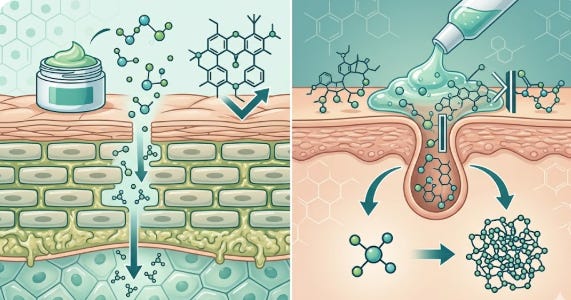
To understand why some things work topically and others fail, we have to look at the skin’s architecture. Your skin is essentially a brick-and-mortar fortress. The “bricks” are dead cells (corneocytes), and the “mortar” is a waxy lipid matrix.
This fortress is designed specifically to keep the outside world out. For a natural compound to get past the “bouncer” at the door, it generally needs to be fat-soluble (lipophilic) and have a low molecular weight (typically under 500 Daltons). If a compound is water-soluble or “charged” (like many minerals), it usually gets stuck on the surface unless it finds a “back door” through a hair follicle or sweat gland.
The Bioavailability Trap
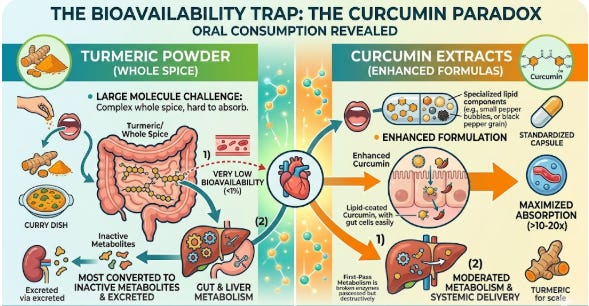
One of the most interesting “missed” angles in this debate is the curcumin paradox. Turmeric is a superstar in the wellness world, but if you take it orally, your gut is remarkably good at destroying it. Oral curcumin has notoriously poor bioavailability; it’s mostly converted into inactive metabolites before it ever hits your bloodstream.
However, when you apply curcumin topically, you bypass the digestive “death trap” entirely. In fact, topical curcumin is a powerhouse for local issues like psoriasis and wound healing because it acts as a selective inhibitor of an enzyme called phosphorylase kinase, which triggers inflammation within minutes of an injury. If you’re using turmeric for systemic health, keep eating it (with fat and pepper!), but for skin inflammation, the topical route is the clear heavyweight champion.
The Magnesium Controversy
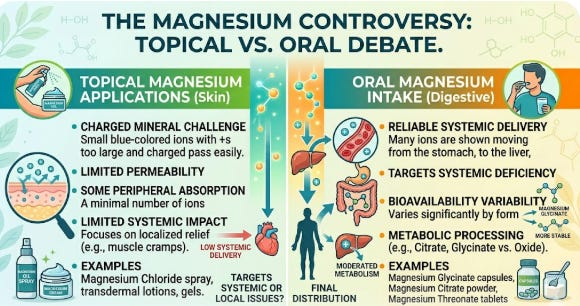
If you look at magnesium, the topical vs. oral debate gets heated. Some experts argue that magnesium is a charged mineral and therefore cannot pass through the skin barrier effectively. They suggest oral supplementation is the only reliable way to fix a systemic deficiency.
However, proponents of transdermal magnesium point to studies showing that magnesium ions can actually enter through hair follicles, which act as high-speed "conduits." Some pilot data even claims that a 12-week topical regimen can raise cellular magnesium levels five times faster than oral tablets.
When Internal is the Only Way
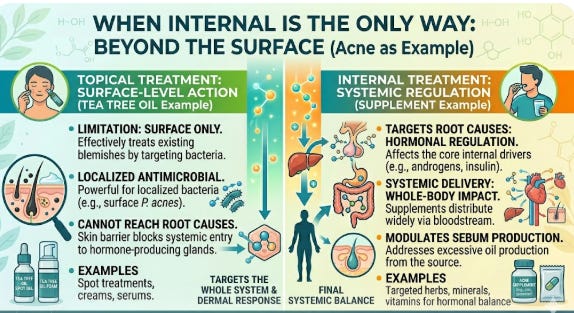
Some issues simply cannot be fixed from the outside. Take acne, for example. While tea tree oil is a fantastic topical antimicrobial for killing surface bacteria, it can’t fix the internal hormonal triggers of acne.
Newer research into the Mediterranean diet and Omega-3 supplementation shows that ingesting high doses of EPA and DHA (about 800mg/400mg) can actually lower levels of IGF-1, a growth factor that drives sebum production and inflammation from within. You could rub fish oil on your face all day (please don’t!), but it wouldn’t change your body’s internal inflammatory signaling the way a supplement does.
The “Contact-Only” Powerhouses
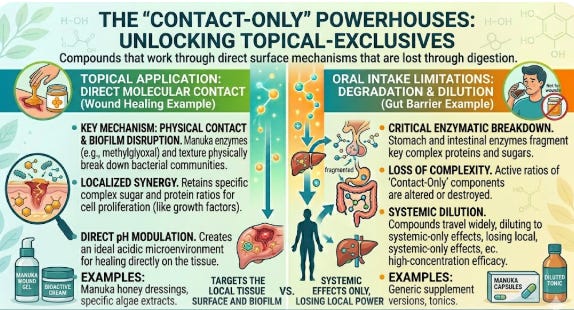
We usually focus on how to get a compound through the skin, but some work best through direct contact because they act locally at concentrations oral use can’t match.
Garlic (Allicin): When applied topically for fungal infections like athlete’s foot, allicin works by physically disrupting microbial cell membranes on contact.
Honey: This is a clinically validated wound treatment that works through an osmotic effect and the release of hydrogen peroxide to kill bacteria externally.
Tea Tree Oil: This is the ultimate “skin-only” champion. It is incredibly effective at disrupting microbial membranes for acne or dandruff, but it is actually toxic if taken internally.
Real Estate Matters
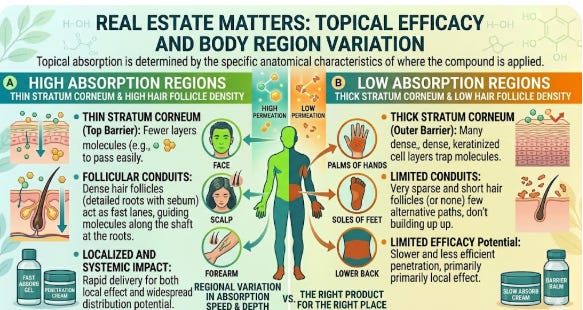
The rules of topical efficacy change depending on exactly where on your body you apply the compound. The thickness of the stratum corneum (the outer barrier) and the density of hair follicles create high-speed “conduits” for absorption.
High-Absorption Zones: Compounds penetrate much faster on the face, scalp, and genitals.
Low-Absorption Zones: The palms of your hands and soles of your feet are such thick “fortresses” that many natural compounds will simply sit on the surface without ever doing deep work.
The Follicle Shortcut: In some cases, like with rosemary oil for hair growth, the compound works because it targets the hair follicle directly—a path oral supplements can only reach through the complex and slower systemic circulatory system.
The most counterintuitive angle is that natural compounds actually work “better” topically when your skin is unhealthy. In healthy skin, the barrier is designed to keep everything out. But in cases of psoriasis, atopic dermatitis, or even a simple scrape, the barrier is compromised.
In one study, the skin deposition of quercetin glycosides (natural anti-inflammatories found in onions and apples) increased 11-fold in compromised skin compared to healthy skin.
This creates a “vicious cycle” or a “virtuous window”: diseased skin allows more medicine in, which then works to heal the barrier until it’s strong enough to keep the world out again.
How to Choose
If you’re trying to decide whether to “slather something on topically or ingest it,” follow this rule of thumb:
If it’s a specific patch of eczema, a sore muscle, or a dark spot, topical application is the obvious winner; it delivers a high concentration of the compound exactly where it’s needed, providing immediate, localized relief.
However, topicals also provide systemic delivery without the “middleman,” with certain compounds passing through the skin and entering the bloodstream directly. This bypasses the digestive system and the “first-pass metabolism” of the liver, which can often break down or diminish the potency of a compound before it ever reaches your cells.
Use internal when the problem is distributed. If you’re dealing with systemic inflammation, joint pain in multiple areas, or trying to build the structural integrity of your skin from the bottom up, your diet is the primary tool.
In short: use your skin for precision and your diet for prevention. When you align your delivery method with your specific health goal, you stop guessing and start seeing strong results.
✨ StrongHealth articles are free so that all can benefit. But if unbiased and evidence-based research resonates with you, consider supporting it with a paid subscription using the link below.
✨ Or a small Ko-fi contribution that lets me keep this work accessible.
🌿 © 2026 (C) Jorg Mardian; “StrongHealth” on Substack.com