

Why Mobility Training Matters More Than You Think
How joint movement, posture, recovery, and long-term function are shaped by mobility


Your body was built for movement. Not the narrow range we’ve reduced it to, shuffling from the car to a desk or bending over to grab something off the floor, but full-spectrum movement: twisting, hinging, rotating, reaching, loading, and changing direction.
That kind of movement used to be normal. Now most people spend their days seated, standing in place, or repeating the same few motions. Over time the body adapts to that confinement. Joints lose range and muscles shorten, while the nervous system forgets how to coordinate complex movement. And after a while, life just starts to feel harder than it should.
Mobility training exists to reverse that process. It’s the deliberate practice of restoring the range of motion your joints were built to have and teaching your body how to control that range with strength and precision. When that system is working, you feel it everywhere: in how you wake up, in how your body handles hard work, in how quickly you recover, and in whether you are still moving well decades from now.
Mobility Versus Flexibility
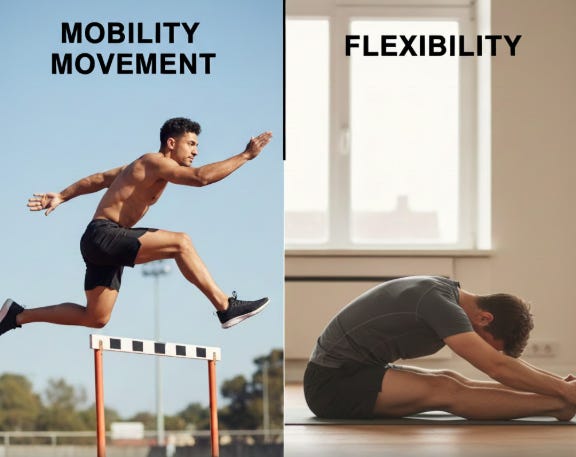
Flexibility is passive. It measures how far a muscle can be pushed.
“Flexibility is defined as the range of motion available to a joint or a series of joints, typically measured passively with an external force.”
→ Alter MJ. Science of Flexibility. 3rd Edition. Human Kinetics, 2004.
Mobility is active. It is your ability to take a joint through its full range under your own control.
“Joint mobility refers to the ability to move a joint actively through its range of motion with stability, coordination, and control.”
→ Kiesel K, Plisky P, Butler RJ, et al. Scandinavian Journal of Medicine & Science in Sports. 2014;24(6):1017–1023.
That latter distinction matters because unused range is dead range. Without neurological control and muscular strength, flexibility does nothing for real movement. Mobility training builds both while also accelerating recovery.
After hard training the instinct is often to stop moving and wait for soreness to pass. But low-intensity mobility work the following day is one of the most effective recovery tools available. Controlled movement increases circulation without adding meaningful stress. That blood flow clears metabolic waste and delivers oxygen and nutrients to damaged tissue. The result is less soreness and faster restoration of performance.
The same principle applies after long periods of sitting. The stiffness you feel after meetings or driving begins as a circulation problem, and over time it becomes a structural one. When that system is restricted, posture fails automatically. This is why most posture advice doesn’t work. It asks you to fight your own structure. Tight hips tilt the pelvis and compress the lower back. A rigid thoracic spine forces the shoulders forward. The body cannot organize itself properly because it lacks the mechanical freedom to do so.
A short mobility session removes the barriers, and alignment starts to correct itself. With open hips and a spine that can extend and rotate again, the skeleton stacks naturally. Posture becomes effortless, and movement regains its ease.
Mobility Preserves Joint Health
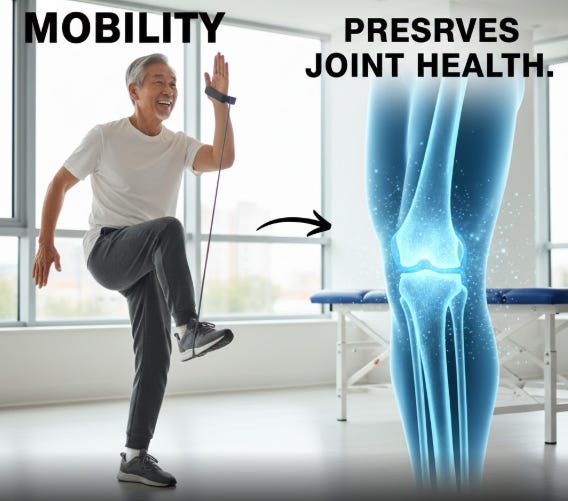
Cartilage has no direct blood supply. It depends on synovial fluid produced by the joint itself. Movement is what circulates that fluid. When you take joints through their full range, you are feeding the tissue that keeps them functional, and joints remain resilient. Without that movement, cartilage deteriorates. This is why sedentary people develop joint pain even without injury. The tissue is starving.
Mobility training is the antidote because it prevents injury by restoring proper load distribution. When one joint cannot do its job, another compensates. Those compensations accumulate until something fails. Tight hips during a deadlift push stress into the lower back. A locked thoracic spine overloads the shoulders in overhead work. These patterns account for most non-contact injuries. Mobility training corrects the system by making sure each joint carries its proper share of the load.
Loss of mobility is also one of the earliest signs of decline. Difficulty rising from the floor, reaching overhead, and maintaining balance—these are not inevitable features of aging; they are the consequences of long-term movement loss. People who protect their mobility into their later decades move differently. They remain capable because their bodies still work the way they were built to.
As George Burns put it, you don’t get old and stiff; you get stiff and then you get old. The sequence matters.
What this means for you is that mobility training is not optional. It’s the foundation beneath strength, endurance, recovery, posture, joint health, and long-term resilience. You don’t need hours of it. Twenty minutes, three times a week, applied with intention, is enough to produce measurable change. Move your joints through full ranges. Control the motion and build the functional strength.
Start with the tightest, most limited area in your body and work there this week. The response will be faster than you expect.
✨ StrongHealth is a reader-supported publication. My articles are free so that all can benefit, but if unbiased and evidence-based research resonates with you, consider supporting it with a paid subscription using the link below.
✨ Or a small Ko-fi contribution that lets me keep this work accessible.
🌿 © 2026 (C) Jorg Mardian; “StrongHealth” on Substack.com
Baby steps. Gentle stretching when I wake up. Helps me.